As generative AI engines take the wheel in deciding what we see, read and remember, GEO raises a question beyond algorithm optimization: whose stories survive the next wave of digital memory, and whose fade away? This page covers three parts of that question. First, why citation by AI matters. Second, the repeated work of staying cited. Third, how to pick a tool that tracks your AI visibility.
1Why being cited matters
1.1When AI becomes the librarian
AI models like ChatGPT and Gemini are the new librarians of the web. They decide which facts surface, which sources get cited and which voices echo across the digital landscape. They make these choices based on what is already online, what is popular and what is easy to parse.
The loudest, most-linked and most-optimized content rises to the top. Niche expertise, local knowledge and unconventional perspectives risk getting buried. If you are not in the training data, you are not in the answer.
1.2The power and the problem of citation
Reference rate is the new currency. If AI cites your work, you get noticed. If it does not, you might as well not exist. This changes the game for big publishers, indie creators and communities working on the margins.
When a user asks an AI a question, the model pulls from its training data and the live web. Sources are not equal. Well-optimized, frequently cited content rises to the top. Smaller voices, niche communities and non-mainstream perspectives fade into the background.
AI models are trained on what is available and visible. If your content is not structured for AI, or you do not play by the rules of GEO, your knowledge can slip through the cracks. The danger goes beyond being ignored. It includes being forgotten.
1.3Whose knowledge gets preserved
The web was supposed to democratize information. Now algorithms risk deciding whose knowledge gets preserved and whose gets left out. Smaller voices, niche communities and non-mainstream perspectives have always had to fight for visibility. With generative AI, the stakes are higher.
If generative search never cites a local historian's blog, does that knowledge survive? If an AI answer never summarizes a community's lived experience, does it fade from collective memory? These questions are about the future of what we know and who we listen to, as much as they are technical.
1.4What we owe each other as stewards of knowledge
Writers, editors and builders of digital spaces are part of this story. What you publish, how you structure it and who you cite decide what gets remembered. Some hard questions to ask:
- How do we make sure algorithmic convenience does not erase underrepresented voices?
- What can we do to keep the web weird, diverse and surprising?
- How do we balance optimization with authenticity?
GEO gives us tools to surface knowledge, and a responsibility to use them. We can lift up stories that might otherwise get lost. We can design for discoverability without flattening everything into the same template.
If AI is the new librarian, its shelves should not be missing the best, strangest and most vital books. Who gets to be remembered is not written yet. It is up to us to make sure the answer includes the ones that matter most, and not only the loudest voices.
2The grind of staying cited
GEO is easy to describe as a checklist: optimize your memo, track your reference rate, celebrate when an AI finally quotes you. The reality is messier. Staying visible in the age of generative engines is a cycle of writing, tracking, editing and adapting, with no single win to bank.
2.1The never-ending update loop
You publish a guide. AI models may pick it up for a few days, which feels good. Then a model update rolls out, or a competitor rewrites their page, and your memo drops off the citation radar. You go back in. You tweak the summary, sharpen the bullets and check whether your FAQ still matches the questions people actually ask.
GEO is a constant race against entropy. The web shifts, the models shift, and you shift with them.
2.2Tracking takes grit
Manual tracking is tedious, automated dashboards break, and reference rates dip for no clear reason. You end up running batch prompts at midnight or scanning Discord alerts before your morning coffee. Sometimes you spend hours chasing a 2 percent lift that nobody outside your team will notice.
The grind is the point. Anyone can optimize once. The teams that win keep watching, keep iterating and never let their memos slip into obscurity.
2.3Editing without ego
Your favorite turn of phrase might never get quoted. A clever intro gets cut if it does not help your reference rate. The best GEO writers kill their darlings, rewrite for clarity, and structure for the machine as much as for the human. The aim is to be useful, be clear and be the answer the AI needs.
2.4The invisible work
Readers see the polished memo. They do not see the ten drafts before it, the Discord threads, the "why did our FAQ drop to 5 percent?" debates or the late-night fixes after a model update. The real craft lives in those details, in the persistence, and in the willingness to keep pushing when the numbers do not move.
2.5Why it is worth it
GEO is not glamorous and not always fun. But when an AI cites your memo, or your niche topic finally shows up in a generative answer, you know you earned it. You put in the work to make sure your knowledge survives. It is not for everyone, and if you want your work to matter in the age of AI, it is the way to stay seen.
3Choosing an AI visibility tool
AI visibility tracking is no longer optional if you want your content to stay seen. New tools appear every month, so picking one can feel like a maze. The steps below cover what to look for and how to avoid a tool that does not fit your workflow.
3.1Start with your real use case
Before you look at dashboards or pricing, get clear on what you need. Do you track brand mentions, content citations or competitor visibility? Do you want daily alerts or monthly reports? The right tool matches your actual workflow, and a good demo does not guarantee that.
3.2Vet the data source
AI visibility tools pull data in different ways. Some use direct API access, others scrape model outputs, and a few rely on third-party panels. Ask these questions:
- Which AI platforms are tracked (ChatGPT, Gemini, Perplexity, Google AI Overviews and others)?
- How fresh is the data: real-time, daily or weekly?
- Can you see the raw outputs or only summaries?
If the vendor cannot answer these, keep looking.
3.3Popular tools
- Profound: Strong for enterprise teams, with detailed tracking and competitor analysis.
- AthenaHQ: GEO-focused, with daily tracking and actionable insights.
- Semrush: Expanding into AI tracking with its established SEO toolkit.
- AI Visibility, Peec AI, Rankscale, Otterly.AI: Each offers a slightly different spin. Compare features, pricing and ease of use.
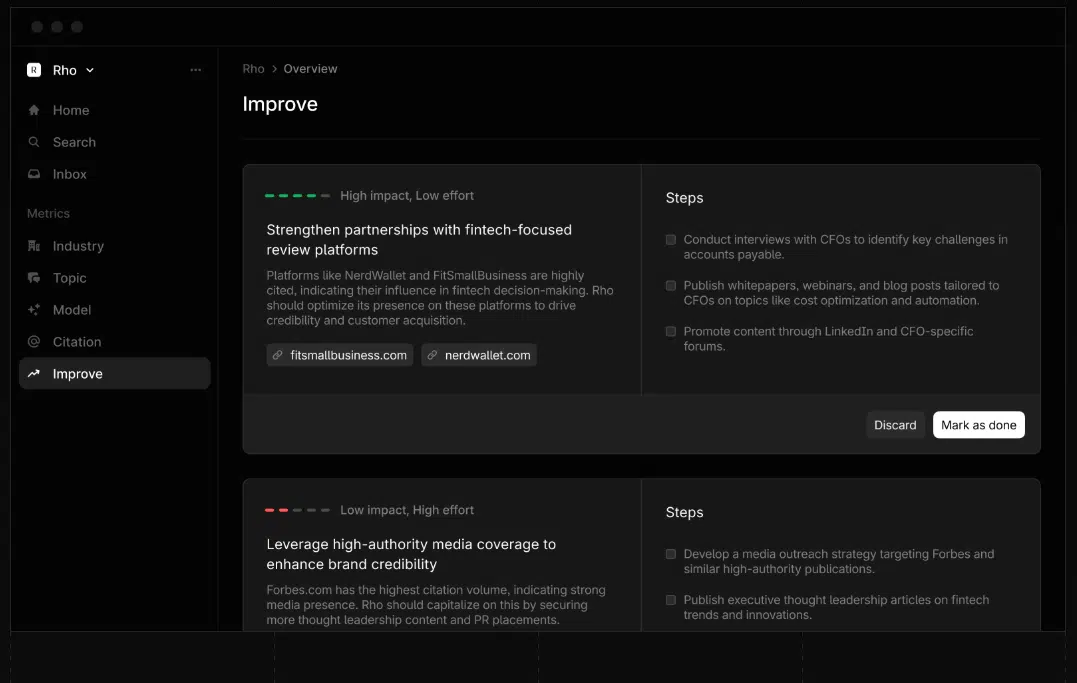
3.4Test before you commit
Most tools look slick in a sales pitch. The real test is running your own prompts and checking whether the results match what you see in live AI answers. Try a trial or demo with your actual memos or brand terms. If the tool's numbers do not line up with reality, that is a red flag.
- Ask for a demo or trial. Do not sign a long contract without hands-on testing.
- Run your own prompts and compare the tool's results with live AI answers.
- Get feedback from both writers and engineers. Everyone needs to be able to use the tool, not just the analytics team.
3.5Check the basics
- Is the pricing clear, or are there hidden fees?
- Does it fit your budget and scale as your needs grow?
- Can your whole team use it, or is it locked to a few seats?
3.6Consider support and adaptability
AI search moves fast. You want a tool that updates quickly and has support you can reach when things break or change. Ask about update cycles, new feature rollouts and how fast the vendor adapts to new AI platforms.
3.7Solo writers and small teams
You do not need the biggest tool on the market. Look for platforms with clear dashboards and no-code setup. Even basic tracking beats flying blind.
3.8FAQ
Do I need to track every platform?
Start with the ones your audience uses most. Expand as you grow.
What if my tool's data does not match what I see in ChatGPT?
No tool is perfect. Use tracking as a guide, and double-check with manual prompts now and then.
Choosing the right tool is like picking a compass for the new search landscape. Take your time, test with your real content, and pick the one that helps your team move fast and stay seen.