Radix sort is a non-comparative sorting algorithm that sorts integers by processing individual digits. Unlike comparison-based algorithms (like Quick Sort or Merge Sort), Radix sort groups numbers by their individual digits.
- Digit positioning: Radix sort processes digits from the least significant digit (LSD) to the most significant digit (MSD).
- Stable sorting: It maintains the relative order of records with equal keys.
- Counting sort as a subroutine: Radix sort often uses Counting Sort for sorting digits, ensuring stable sorting at each digit level.
- Determine the maximum number of digits: Find the maximum number in the array to understand the number of digits.
- Sorting by each digit: Use Counting Sort to sort based on each digit's place value
- Initialize Buckets: create an array of buckets for each digit from 0 to the radix minus one (e.g., for decimal numbers, you need 10 buckets).
- Distribute the Numbers: start with the LSD and move towards the MSD. distribute each number into the corresponding bucket based on the current digit
- Collect Numbers: collect numbers from the buckets and update the list in the new order
- Repeat for each digit position: Continue the process for each digit until all positions are sorted.
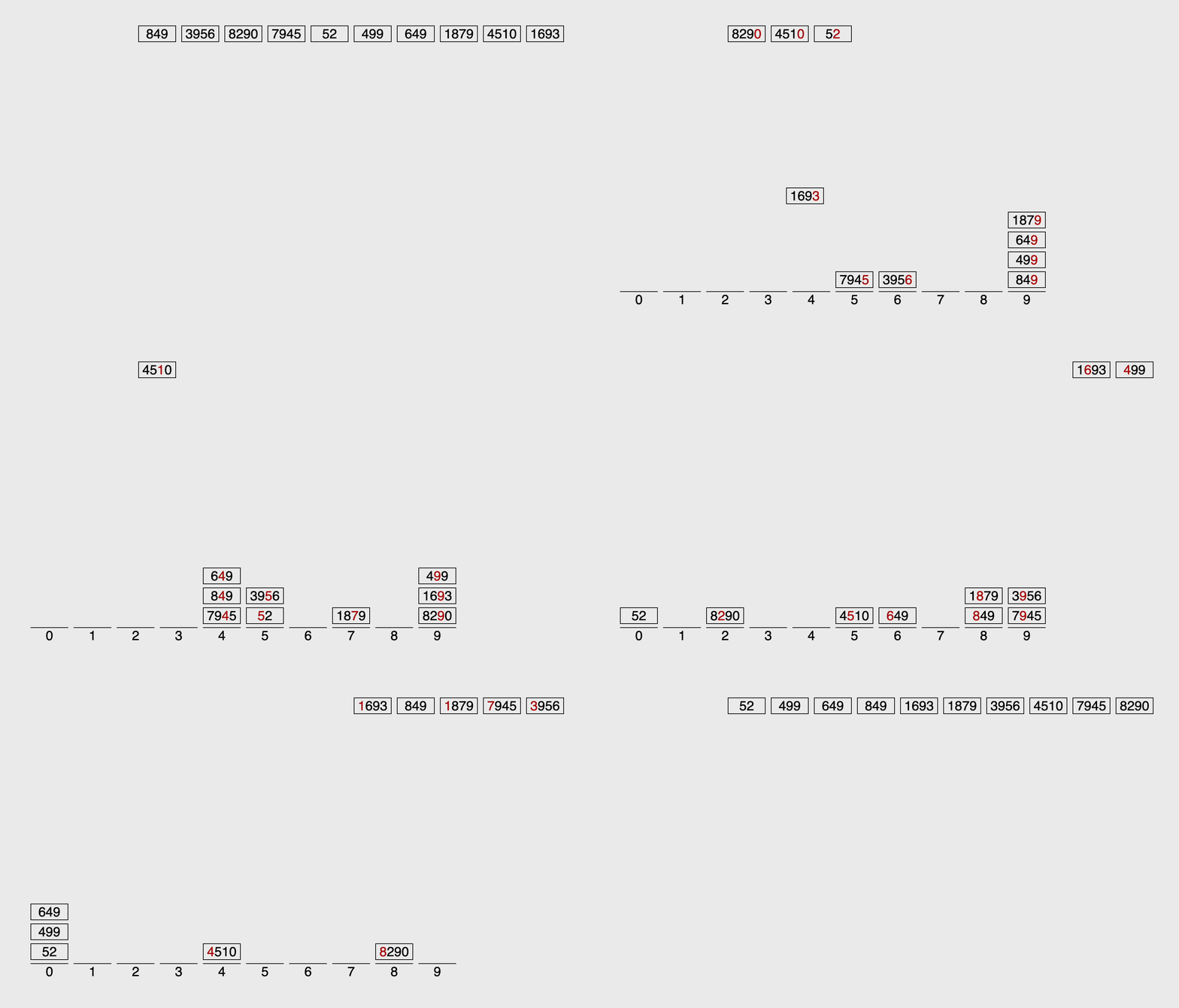
If we take
- n is the number of elements
- k is the number of digits in the largest number
the time complexity for Radix sort will be O(n×k) and the space complexity will be O(n+k)
- Efficiency: Linear time complexity O(n×k) when k is the number of digits.
- Predictable performance: Performs consistently regardless of the input data's initial order.
- Limited scope: Primarily useful for integers or fixed-length strings.
- Memory usage: Requires additional memory for the Counting Sort process.