A state machine is a model with a fixed set of states and rules for moving between them. Four related models cover most of what a programmer meets: the finite-state automaton, the finite-state transducer, the Mealy machine and the Moore machine. The last three extend the first. This note walks them in that order, with the formal definition and a code example for each, then compares them.
1Finite-state automata
A finite-state automaton (FSM, FSA, plural automata) is better known as a state machine. It is a mathematical model with one constraint: the abstract machine can be in exactly one of a finite number of states at any point in time. A state is typically a string or an equivalent enumeration.
1.1Mathematical model
The Wikipedia page on finite-state machines defines a deterministic finite-state machine by five variables, a quintuple: (Σ,S,s0,δ,F).
- Σ is the input alphabet (a finite non-empty set of symbols). In our terms, these are the events.
- S is a finite non-empty set of states.
- s0 is the initial state, an element of S.
- δ is the state-transition function: δ:S×Σ→S.
- F is the set of final states, a (possibly empty) subset of S.
Given an initial state s0, the transition to the next state is:
To reach a final state from a known set of states, the transition looks like this:
1.2Simplified meaning
For practical work, one idea is enough. A transition function takes a state and an event and returns a new state. The type of the state and the subset it belongs to is up to the developer.
type State = string
type Event = string

const transition = (state: State, event: Event): State => ...
1.3Coming from algebraic data types
If you know algebraic data types (ADTs), a state machine is a set of nested ADTs that encode states and events as data types. The example below nests pairs of sum (union) types, in ReScript:
type elapsed = float;

type taskStatus =
  | NotStarted
  | Running
  | Paused
  | Done;

type input =
  | Start
  | Pause
  | Resume
  | Finish;

let transition = (state, input) =>
  switch (state, input) {
  | (NotStarted, Start) => Running
  | (Running, Pause) => Paused
  | (Running, Finish) => Done
  | (Paused, Resume) => Running
  | (Paused, Finish) => Done
  | (Running, Tick) => Running
  | _ => state
  };
1.4States in the domain
In Domain Driven Design (DDD) and in Event Storming, states do not seem to have a place in the domain. The likely reason is the separation of concerns between the behavior of commands and what gets updated in the aggregate. DDD does classify entities, such as customer statuses, and those classes carry business meaning. DDD says nothing about technical concerns: where state persists, where a transition should happen, or which effects should follow. For background, see the overview of domain driven design.
2Finite-state transducers
A finite-state transducer is a finite-state automaton that has both inputs and outputs. In Turing machine terms, these are two separate tapes:
- input tape: a set of strings or related data.
- output tape: a set of relations generated from the input tape.
A plain automaton has only the input tape.
2.1Mathematical model
The UC Davis outline on transducers uses variables that match the automaton above. By that classification, a deterministic finite-state transducer has seven main variables, a septuple: (Σ, S, Γ, δ, ω, s0, F).
- Σ is the input alphabet (a finite non-empty set of symbols), our events.
- S is a finite non-empty set of states.
- Γ is the output alphabet.
- δ is the state-transition function: δ:S×Σ→S.
- ω is the output-transition function: ω:S×Σ→Γ.
- s0 is the initial state, an element of S.
- F is the set of final states, a subset of S.
- δ⊆S×(Σ∪{ϵ})×(Γ∪{ϵ})×S (where ϵ is the empty string) is the transition relation.
From an initial state s0, a transition to the next state with an output symbol is:
Reaching a final state from a known set of states looks almost the same:
Transducers that have a final state recognize languages. That is why they are used in natural language processing.
2.2Simplified meaning
There are several ways to write a transducer, and it is not always a beefed-up state machine. To oversimplify, model it close to a regular state machine:
type State = string
type Input = string
type Output = {...} //

const transition = (state: State, input: Input): Output => ...
When the output is a product type of the output itself and the next state of the transition, the machine is a Mealy machine (next section).
2.3Examples
Reducers are single state machines, but the canonical reducers in Redux and React are close to transducers, because they return state or objects as the notion of an output. See reducers for the single-state-machine view.
// https://reactjs.org/docs/hooks-reference.html#usereducer
// our outputs here is the { count: number } object
const initialState = { count: 0 }

function reducer(state, action) {
  switch (action.type) {
    case 'increment':
      return { count: state.count + 1 }
    case 'decrement':
      return { count: state.count - 1 }
    default:
      throw new Error()
  }
}

function Counter() {
  const [state, dispatch] = useReducer(reducer, initialState)
  return (
    <>
      Count: {state.count}
      <button onClick={() => dispatch({ type: 'decrement' })}>-</button>
      <button onClick={() => dispatch({ type: 'increment' })}>+</button>
    </>
  )
}
Take the task example from the automaton section and wrap state, inputs and outputs together (ReScript):
// elapsed represents our arbitrary output
type elapsed = float;

// elapsed here is used in a constructor as an arbitrary output
type taskStatus =
  | NotStarted
  | Running(elapsed)
  | Paused(elapsed)
  | Done(elapsed);

// elapsed here is used in a constructor as an arbitrary input
type input =
  | Start
  | Pause
  | Resume
  | Finish
  | Tick(elapsed);

let transition = (state, input) =>
  switch (state, input) {
  | (NotStarted, Start) => Running(0.0)
  | (Running(elapsed), Pause) => Paused(elapsed)
  | (Running(elapsed), Finish) => Done(elapsed)
  | (Paused(elapsed), Resume) => Running(elapsed)
  | (Paused(elapsed), Finish) => Done(elapsed)
  | (Running(elapsed), Tick(tick)) => Running(elapsed +. tick)
  | _ => state
  };
3Mealy machines
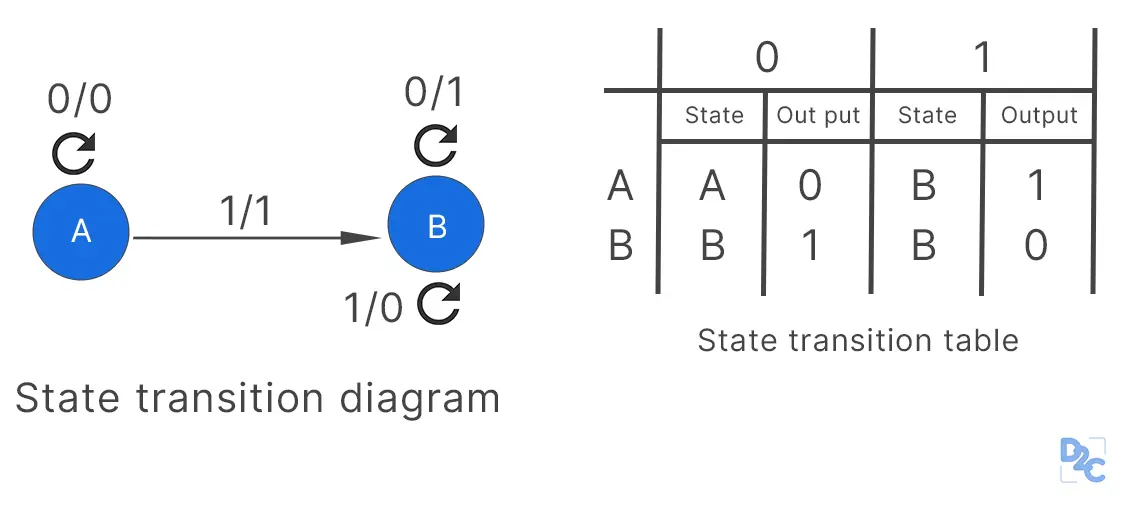
A Mealy machine is a finite-state automaton whose output depends on the current state and the current input. It is the closest definition to a deterministic finite-state transducer.
3.1Mathematical model
A deterministic Mealy machine has six main variables, a sextuple: (Σ, S, Γ, δ, ω, s0). They are the same as the transducer's variables without the final states F. ω is S×Σ→Γ, and the transition relation δ⊆S×(Σ∪{ϵ})×(Γ∪{ϵ})×S applies as before.
Some formulations combine the transition and output functions into one:
From an initial state s0:
3.2Example
The transducer example fits here, because the transition and the output coalesce into one function. This traffic light carries its expiry time (in seconds) as the output:
// expiry represents our arbitrary output (in seconds)
type expiry = float;

// expiry here is used in a constructor as an arbitrary output
type trafficLightStatus =
  | Red(expiry)
  | Amber(expiry)
  | Green(expiry)
  | FlashingRed(expiry)

// elapsed here is used in a constructor as an arbitrary input
type input =
  | ExpireTime
  | Error
  | Restart

let transition = (state, input) =>
  switch (state, input) {
  | (Red(expiry), ExpireTime) => Green(60.0)
  | (Red(expiry), Error) => FlashingRed(30.0)
  | (Green(expiry), ExpireTime) => Amber(60.0)
  | (Green(expiry), Error) => FlashingRed(30.0)
  | (Amber(expiry), ExpireTime) => Red(60.0)
  | (Amber(expiry), Error) => FlashingRed(30.0)
  | (FlashingRed(expiry), Restart) => Red(60.0)
  | _ => state
  };
4Moore machines
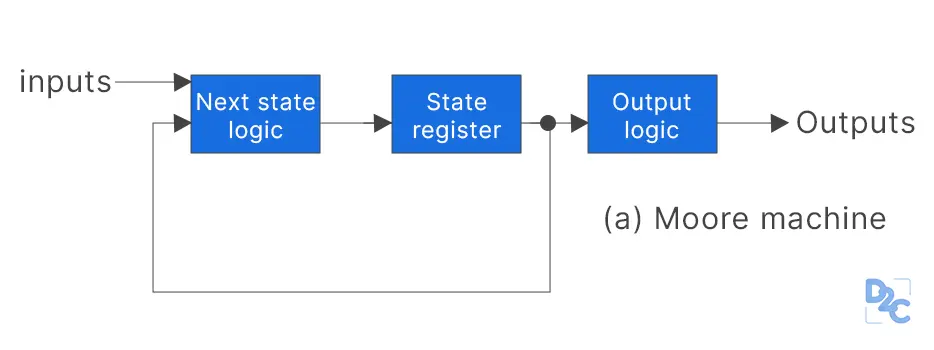
A Moore machine is a finite-state automaton whose output depends only on its current state. It is a restricted type of finite-state transducer.
4.1Mathematical model
A deterministic Moore machine has the same six variables as a Mealy machine, with one change: the output function takes only the state, ω:S→Γ.
- Σ is the input alphabet, our events.
- S is a finite non-empty set of states.
- Γ is the output alphabet.
- δ is the state-transition function: δ:S×Σ→S.
- ω is the output-transition function: ω:S→Γ.
- s0 is the initial state, an element of S.
- δ⊆S×(Σ∪{ϵ})×(Γ∪{ϵ})×S is the transition relation.
From an initial state s0:
4.2Example
Unlike a Mealy machine, a Moore machine cannot merge the transition and output functions into one. The output function is synchronous to the state change. The same traffic light looks like this (ReScript):
type trafficLightStatus =
  | Red
  | Amber
  | Green
  | FlashingRed

type input =
  | ExpireTime
  | Error
  | Restart

type outputFn = (state) =>
  switch (state) {
  |  Red => (Red, 60.0)
  |  Green => (Green, 60.0)
  |  Amber => (Amber, 60.0)
  |  FlashingRed => (FlashingRed, 30.0)
  }

let transitionFn = (state, input) =>
  switch (state, input) {
  | (Red, ExpireTime) => Green(60.0)
  | (Red, Error) => FlashingRed(30.0)
  | (Green, ExpireTime) => Amber(60.0)
  | (Green, Error) => FlashingRed(30.0)
  | (Amber, ExpireTime) => Red(60.0)
  | (Amber, Error) => FlashingRed(30.0)
  | (FlashingRed, Restart) => Red(60.0)
  | _ => state
  };

let output = outputFn(transitionFn(Red, ExpireTime)) // (Green, 60.0)
5How they differ
| Model | Output | Final states |
|---|---|---|
| Finite-state automaton | None | Yes |
| Finite-state transducer | Depends on state and input | Yes, when it recognizes languages |
| Mealy machine | Depends on state and input | No |
| Moore machine | Depends on state only, changing in step with it | No |
Against formal transducers. Mealy and Moore machines are generators and do not recognize languages. For that reason they have no concept of a final state. The transducers that do have final states recognize languages, which is what natural language processing needs.
Between Mealy and Moore. Both are generator-type state machines and both can parse a regular language. A Mealy output depends on both the state and the input. A Moore output changes synchronously with the state. The two are equivalent:
Every Moore machine can be converted to a Mealy machine and every Mealy machine can be converted to a Moore machine.
6Where it breaks down
Beyond very simple examples, state machines grow numerous states, many with identical transitions. That growth is the state explosion problem, and statecharts address it with parallel states, hierarchical states and guards. The note State explosion covers it.
7References
- Turing machine
- Finite-state machine
- Finite-state transducer
- Mealy machine
- UC Davis outline on transducers
- t-pl.io: DDD, aggregates, processes, state machines and transducers
- React useReducer
- dl.acm.org/doi/10.5555/972695.972698
- web.stanford.edu: fst-in-nlp
- wickstrom.tech: finite-state machines, part 1
- dev.to: modelling domain with state machines in ReasonML
- blog.honosoft.com: partial state machine
- Unstop.com: difference between Mealy and Moore machine